Americans, Scorpions and Ants
1.
“If people bring so much courage to this world the world has to kill them to break them, so of course it kills them. The world breaks every one and afterward many are strong at the broken places. But those that will not break it kills. It kills the very good and the very gentle and the very brave impartially. If you are none of these you can be sure it will kill you too but there will be no special hurry.”
― Ernest Hemingway, A Farewell to Arms
I’ve been engaged in a lot of rereading of late. Due to the exhuming of my first novel, A Mouthful of Stones, I’ve had to start thinking about it again in light of criticism I was given by a publisher. In short, said publisher was very encouraging but believes the book has shortcomings and I’m trying to address them.
The main problem is that anything you write makes perfect sense to you, and the skill part of the activity comes down to presenting your own ideas in terms that make sense to a reader. The difficulty is compounded by the fact that no matter what you do, certain people will never get it, and the more you try to reach them, the more you’ll damage what’s strong in your work.
This is the greatest pitfall: knowing when to move towards a reader and when to make them come to you.
I first read A Farewell to Arms at university: I think I was about nineteen. I remember being deeply impressed as I sailed through the peaks and troughs of the story. It may have been the first Hemingway I read, and since that time, I’ve read almost his entire ouvre.
I’ve also read War and Peace a couple of times, and Hadji Murat, both by Leo Tolstoy. Hemingway once said that Tolstoy wrote about war better than anyone else, and I think, once you read Hadji Murat, you can see something of a blueprint for Hemingway’s works, both in terms of A Farewell to Arms and For Whom the Bell Tolls.
Hadji Murat features an American character, Baker. Tolstoy appears to have inserted him to provide a shift in perspective and identification, while Hemingway takes this strategy one step further and in both his aforementioned novels, makes an American his protagonist in foreign wars.
Hemingway is celebrated as a revolutionary stylist. His writing is often described as journalistic, which I understand to be a ‘just the facts’ style of presentation. Hemingway casts you into the action with a minimum of authorial interference; you are plunged into the storm of events without an omniscient intelligence to guide you or hold your hand.

This is the novelistic equivalent of the existential dilemma: the reader is condemned to be free. This is a complete, relentless freedom to confront the world of the novel, and what happens within it, without the reassurance of an omniscient perspective or insight.
However, while the author may be dead there’s something of the Ouija board about any ‘great’ novel both textually and subtextually. No matter how much Hemingway tries to mute his own presence, both the structure and metaphors themselves become profound communications from the other side.
I didn’t remember the following scene from the first time I read the novel, but during the course of my second reading, I felt the true centre of the book’s universe was Frederic Henry’s moment with his own thoughts, while he waited to find out the result of Catherine’s caesarean section.
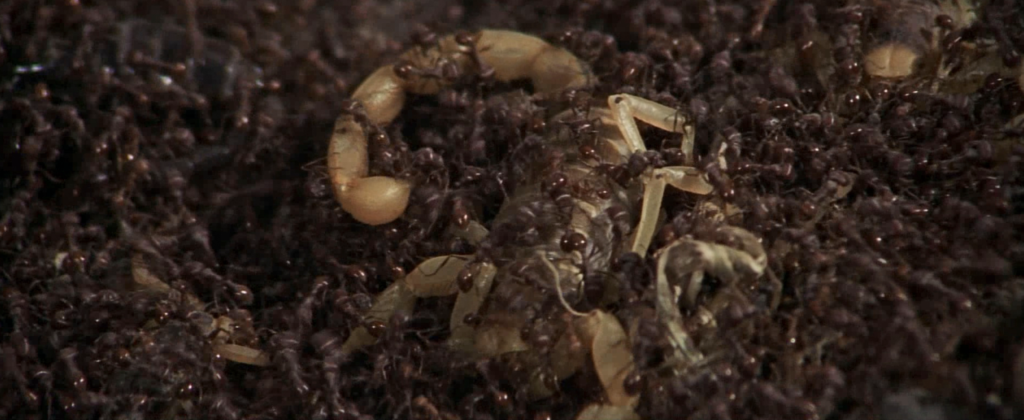
Once in camp I put a log on top of the fire and it was full of ants. As it commenced to burn, the ants swarmed out and went first toward the centre where the fire was; then turned back and ran toward the end. When there were enough on the end they fell off into the fire. Some got out, their bodies burnt and flattened, and went off not knowing where they were going.
But most of them went toward the fire and then back toward the end and swarmed on the cool end and finally fell off into the fire. I remember thinking at the time that it was the end of the world and a splendid chance to be a messiah and lift the log off the fire and throw it out where the ants could get off onto the ground.
But I did not do anything but throw a tin cup of water on the log, so that I would have the cup empty to put whiskey in before I added water to it. I think the cup of water on the burning log only steamed the ants.
-p. 280


 Theme Park at its Darkest
Leave a comment