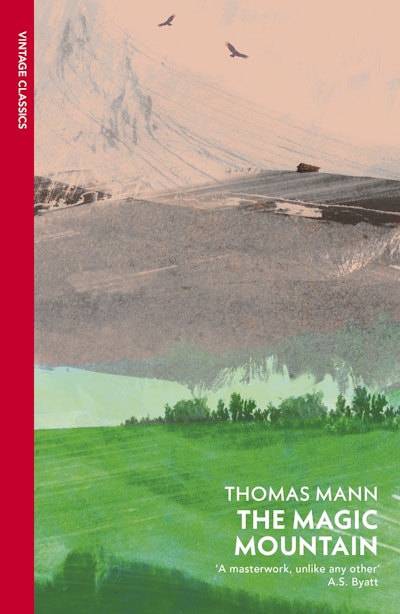
The Magic Mountain
The internet is like having a giant bilge pipe mounted above the armchair in your lounge room with all kinds of garbage gushing out of it. There is hardly a moment to take stock and discriminate amongst the torrent of what’s raining down upon you.
I think the reason it’s become a ubiquitous feature of modern life is that the experience of distraction has become a profoundly effective means for numbing the pain of being alive. It’s both difficult and frustrating for those of us who like to focus our attention, or have developed that focus as a skill.
It also makes the experience of reading ‘classics’ an increasingly difficult undertaking. To Instagram’s credit, however, I did see a clip of Judi Dench reciting Shakespeare’s sonnet 26 from The Graham Norton Show last night, which was absolutely stunning.
Her skill as an actress means she can express such a complex work of art as something simple; as a piece of music, which is one of the most powerful, signatory qualities of poetry. Unfortunately, we’re losing contact with this, just as we’re losing contact with Shakespeare.
Part of the experience of art is to be confused by it, which is almost always a precursor to knowing without understanding, which is probably the sound of the flint spinning in your mind before that conflagration of recogniton: enlightenment.
I’ve been reading The Magic Mountain over the last little while. I’d never read any Thomas Mann before. I’d heard he was one of the great novelists, maybe top ten, and The Magic Mountain is the novel to read. I’ve managed to slog through about three hundred-odd pages and thus far, it’s a real struggle.
Books like this – it runs to about eight hundred pages – require a disciplined persistence. As readers of this blog will know, I approach reading like weightlifting. You have to be disciplined and persistent, and commit to the training session for its duration.
Pavel Tsatsouline, strength and conditioning coach extraordinaire, says strength is the mother of skill, and strength as a reader or a spectator that manifests as submissive, focused attention is effectively a species of meditation and therefore, the most crucial life skill of all.
I would compare reading many of the classics – Tolstoy, Dickens, Dostoyevsky, etc – as being equivalent to a 200kg deadlift. Very few people can walk into a gym and pull that kind of weight off the floor. People that don’t lift don’t see the point, but those that do are profoundly better prepared – and suited – to life on this mortal coil.
To that end, I persist. It took me about 400 pages to get into War and Peace, but it was a life-changing experience and one of the best books I’ve read to date. I’m effectively half-way through The Magic Mountain, however, and I don’t think it’s going to fire.
Which is part of the reason I’ve written the following post. Even though Mann has won a Nobel prize for literature, I have found his novel to be quaint, mannered and laboured. I imagine that Mann probably moved literature forward as a technology, and also probably introduced a lot of cutting-edge ideas relating to psychology into the ‘modern’ conversation at the time it was published. Because those things are now taken for granted, it’s difficult to see his novel as revelatory within its own context.
That said, I read something this morning that is beautifully written. It carries a certain quaintness with it, given the attitude of the spectator, couching its subject in racial terms – which in our cultural context – would be considered gauche or even possibly ‘racist’. This is probably part of what appeals to me – I enjoy the spectacle of other people being offended, and enjoy the adrenalin rush myself.
It’s difficult to know how this would read after emerging from Mann’s pen, given it’s been translated from the German, but without further ado, I present you with the paragraph:
‘A young Moroccan woman, in a costume of striped silk, with trappings in the shape of chains, bracelets, and rings, her swelling breasts half bared, was suddenly brought close to the camera as to be life-sized; one could see the dilated nostrils.
The eyes full of animal life, the features in play as she showed her white teeth in a laugh, and held one of her hands, with its blanched nails, for a shade to her eyes, while with the other she waved to the audience, who stared, taken aback, into the face of the charming apparition.
It seemed to see and saw not, it was not moved by the glances bent upon it, its smile and nod were not of the present but of the past, so the impulse to respond was baffled, and lost in a feeling of impotence. Then the phantom vanished. The screen glared white and empty, with the one word “Finis” written across it.’
P. 316
…That’s pretty much the way it appears. Because of the density of the paragraph as printed in my Vintage edition, and the usage of commas to prolong the image and its aspects in your mind, there’s a kind of exhilaration in the way it opens, almost like an origami animal that’s unfolded to reveal a sketch which was once pleated within its body.
I think there’s also the spectacle of the early twentieth century audience in the cinema, completely dumbfounded by this strange, new technology and the species of revelation it offered.
How innocent they were.

 Theme Park at its Darkest
Leave a comment